Ceiling stains from upstairs
Toilet seals, tub drains and radiator valves in the unit above are the usual sources.
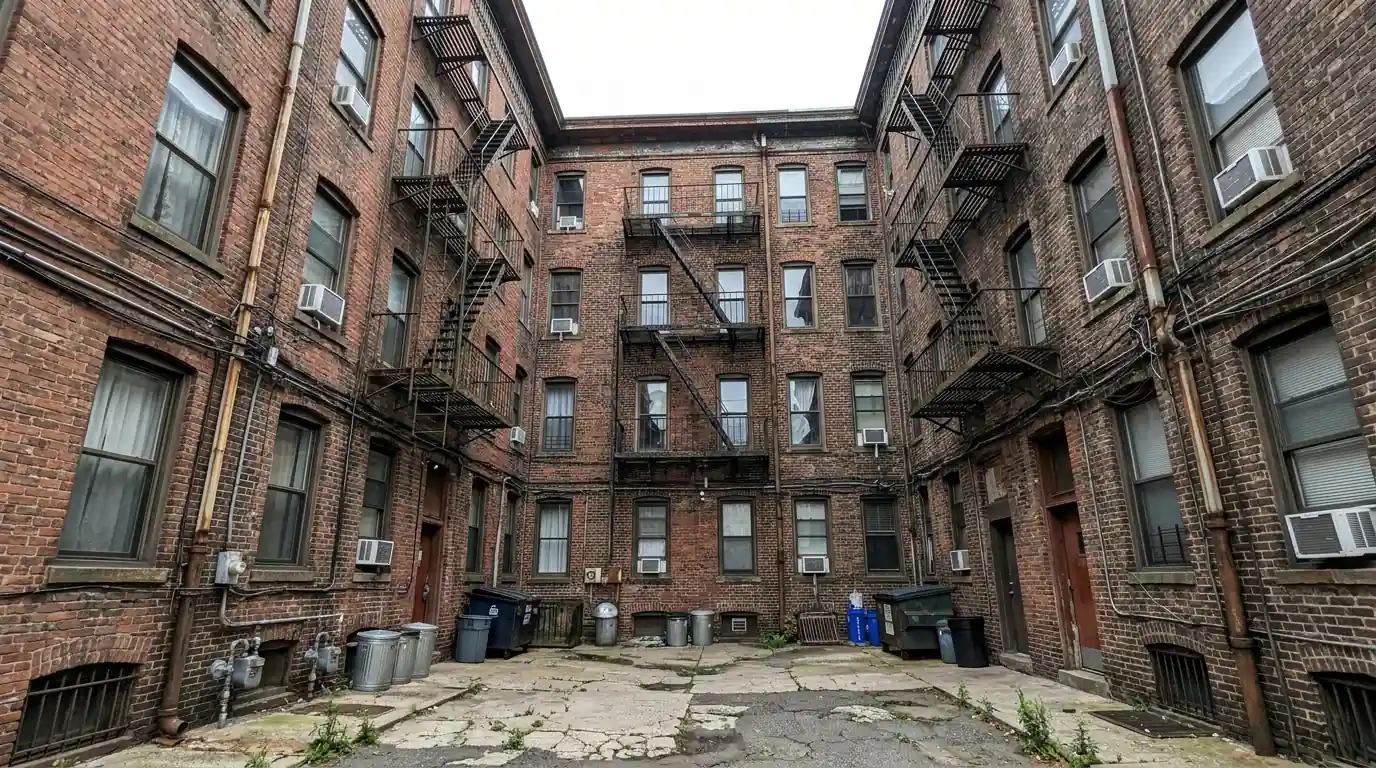
Hudson County is dense, and density changes the mold work. Most calls involve more than one unit, a shared wall or ceiling, or a drain that backs up during storms.
Answering 24/7 from our Johnson St office in Newark
In Hudson County, NJ our mold work centers on multi-unit buildings: leaks from the unit above, bathroom and kitchen mold in apartments, and floor drain backups where most of Jersey City runs on a combined sewer. We come from our Newark office, inspect unit by unit, and write findings tenants, owners and associations can all use.
Most of Jersey City is served by a combined sewer, and its wastewater is piped under the Hackensack River to Newark for treatment by the Passaic Valley Sewerage Commission, a system that serves about 1.4 million residents in 48 towns. When heavy rain overloads those shared pipes, the lowest drain in a building becomes the outlet, and basement units and storage rooms take the water.
In a building with many units, one leak rarely stays in one place. Water runs between floors, along risers and into walls that belong to someone else, which is why tracing the source matters as much as removing the mold.
Toilet seals, tub drains and radiator valves in the unit above are the usual sources.
Undersized or broken fans leave ceilings spotted within weeks of cleaning.
Floor drains in the lowest units back up when the shared sewer overloads.
Unit by unit findings for tenants, owners and condo associations.
See the jobFloor drain and toilet backups in basement units, cleaned to Category 3.
See the jobLeaks from the unit above, dried in place when caught early.
See the jobApartment bathrooms with weak fans and mold on the ceiling or behind the tile.
See the jobHumidity and ventilation readings for stuffy, closed-up apartments.
See the jobOffices, shops and restaurants on the ground floors of mixed buildings.
See the jobAccess is the first thing we plan. For apartment jobs we coordinate with the tenant, the owner or the managing agent, and ask for access to the unit above or the basement when the source is likely there.
We read the affected unit, trace the water through shared walls and ceilings, and photograph each finding with its location, so the report can go to whoever has to pay for the repair.
Yes. We coordinate with management for access, elevators and work hours.
That depends on the lease or bylaws. Our report shows where the water came from, which is what decides it.
Yes, with the landlord's permission. Air samples or dust testing can show a history of mold.
Yes. Sewage backups are cleaned, disinfected and dried, and we note whether a backwater valve would help.
Our dedicated Jersey City page covers the county's largest city in more detail. Across the river, Essex County and Newark are home base, and to the north we cover Bergen County. See the areas we serve page for everything else.
Tell us the unit, the floor and where the water or mold is showing. We will plan access before we arrive.
Map of our Newark service office on Johnson St