Growth behind finished walls
Paneling and drywall closed up after a flood hide mold for years.
In Clifton, a lot of the mold we find dates back to one storm. Basements that flooded during Ida and were dried too quickly or closed up too soon are still showing it.
Answering 24/7 from our Johnson St office in Newark
In Clifton, NJ our mold work is mostly basement moisture and the growth left behind by flooding: finished basements that took water in a big storm, paneling and carpet that were never fully dried, and dark growth that turns up years later. We test to identify it, find the moisture source and remove it under containment.
During Ida in 2021, Clifton streets turned into rivers and basements flooded across the city, and the storm dropped 8 to 11 inches of rain across a corridor of northern and central New Jersey. Many basements were pumped out and cleaned in a hurry.
Where the drywall, paneling or insulation stayed wet behind finished walls, the mold kept growing out of sight. Dark growth on basement drywall in Clifton is often a sign of that kind of slow dry-out, and testing tells us whether it is a long-term water mold.
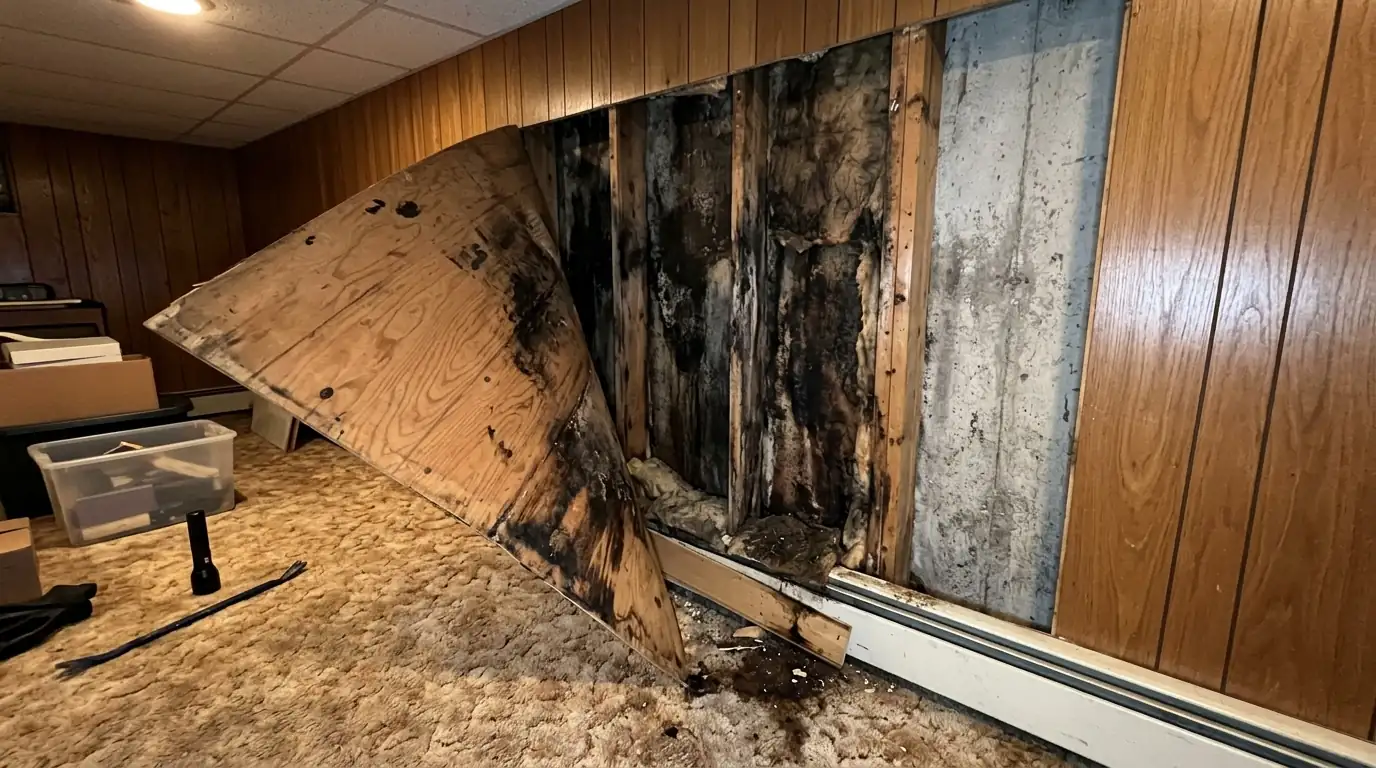
Paneling and drywall closed up after a flood hide mold for years.
Long-term water molds point to walls that stayed wet.
Musty air often traces back to one wall cavity or one carpet.
Identifying dark growth on basement drywall.
See the jobFinished basements opened, cleaned and dried.
See the jobFinding the source when nothing is visible.
See the jobContained cut-outs of affected wall sections.
See the jobKeeping a dried basement below the mold threshold.
See the jobChecking flood history before you buy.
See the jobWe ask first whether the basement flooded and how it was cleaned up. Then we read behind paneling and under carpet, look into wall cavities with a borescope, and sample dark growth where identifying it would change the plan.
Removal follows the readings, not the visible spots, because growth behind finished walls is usually larger than what shows.
If it was finished and closed up quickly, yes. Readings behind the walls show whether it dried.
A lab sample tells you. Color alone cannot.
Yes, from the Newark service office. It is a short drive.
Yes, inside your contingency window, with attention to past flooding.
Clifton is part of Passaic County, which we cover in full, and Paterson is just to the north. To the south is Essex County and our Newark office. The areas we serve page explains the rest.
Tell us whether it flooded and what you are seeing or smelling now. We will plan the visit around it.
Map of our Newark service office on Johnson St